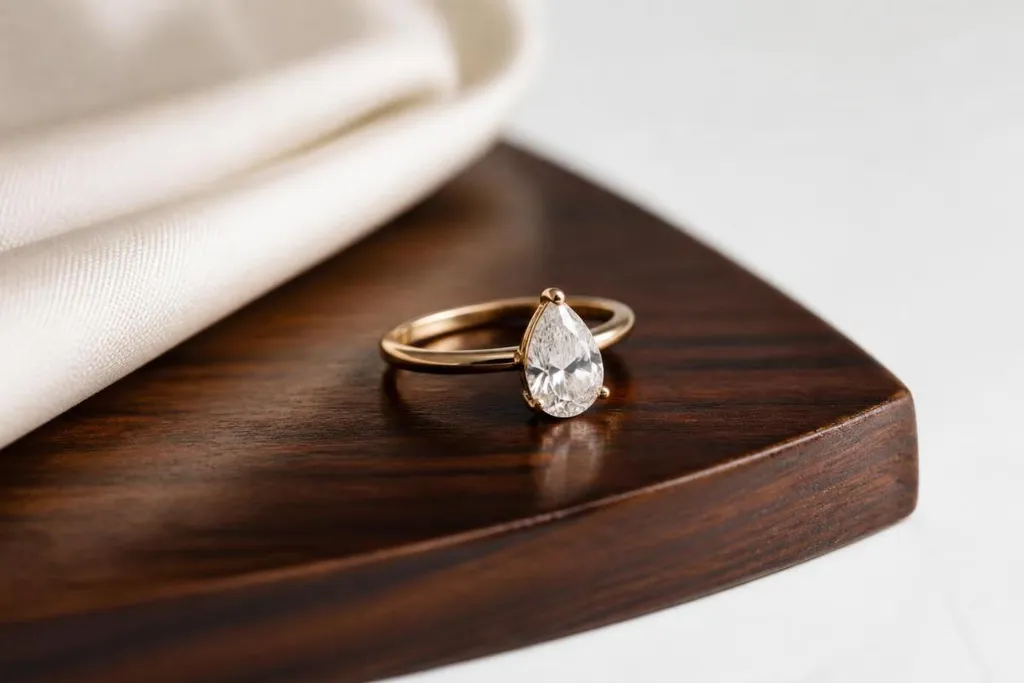
Few diamond shapes have the immediate personality of a pear cut. Rounded at one end and tapering to a precise point at the other, its teardrop silhouette combines the softness of a brilliant cut with a sense of direction that makes the ring feel distinctive. It can look romantic, contemporary or dramatic depending on its proportions and setting.
Exploring beautiful lab diamond pear cut rings also shows why choosing a pear-shaped lab diamond requires more than simply settling on carat weight. Length, width, symmetry and the relationship between the curved and pointed ends all influence the stone's character. Add the setting, band and orientation, and the same fundamental shape can produce remarkably different engagement ring styles.
Finding the Right Pear-Shaped Proportions
Pear-cut diamonds can range from relatively full, rounded shapes to long, slender silhouettes. Length-to-width ratio helps describe that difference, but there is no single proportion that will suit every wearer.
A fuller pear has a stronger curved end and can create substantial presence through the centre of the finger. A more elongated stone draws the eye vertically and may produce a particularly graceful, lengthening effect.
Symmetry deserves careful attention. If an imaginary line were drawn from the point through the centre of the diamond, the two sides should appear well balanced. Uneven shoulders or a point that feels slightly off-centre can be noticeable because the shape itself is naturally directional.
The transition from the rounded end into the point should also look smooth. A beautifully proportioned pear feels fluid rather than abruptly narrowing.
Think Beyond Carat Weight
Carat describes weight, not visible dimensions. That distinction is particularly useful with pear-shaped lab diamonds because their proportions can distribute weight very differently.
Someone may choose a 2-carat pear because they want a long silhouette with significant finger coverage, not simply because a larger carat figure sounds more impressive. Another wearer might find that a well-proportioned 1-carat or 1.5-carat stone creates the delicate effect they prefer, especially when paired with a fine band.
Actual length and width should therefore be considered alongside carat weight.
Pear brilliant cuts can also display a bow-tie effect, where an area of contrast appears across part of the centre. Some contrast contributes to the visual pattern of a faceted diamond, but an overly prominent dark bow tie can distract from its brightness. Assessing the stone visually under different lighting conditions can be more informative than relying on specifications alone.
Choose a Setting That Protects the Shape
The pointed end gives a pear diamond its distinctive character, but it also requires thoughtful protection. A claw positioned at the tip is commonly used to help shield this more vulnerable area.
The rest of the setting should allow the outline to remain clearly visible. A solitaire does this particularly well, placing the asymmetry of the pear at the centre of the design. Diamond-set shoulders add sparkle along the band without substantially altering its silhouette.
A halo creates a more decorative interpretation, following the teardrop outline and increasing the ring's overall face-up presence. A hidden halo can add detail beneath the centre diamond while preserving a cleaner appearance from above.
Band width matters too. Fine bands can emphasise the scale of the pear by contrast, while a slightly wider band may provide better visual balance for a larger centre stone.
Styling the Directional Silhouette
Pear diamonds offer an unusual styling decision: which way should the point face? There is no compulsory orientation.
Wearing the point towards the fingertip can accentuate the stone's length and is perhaps the most familiar arrangement. Turning it towards the hand creates a subtly different impression and may suit someone looking for a less conventional presentation.
Metal provides another way to personalise the ring. Platinum and white gold create a crisp backdrop that blends naturally with a colourless lab diamond. Yellow gold introduces warmth and definition, while rose gold can soften the shape's dramatic point. It is also worth considering the wedding band early. Depending on the gallery and setting profile, a straight band may sit neatly alongside the engagement ring, while other designs may pair more comfortably with a curved or shaped band.
Final Thought
Pear-cut lab diamond rings are compelling because their beauty depends on contrast: softness against a sharp point, brilliant sparkle within an asymmetric outline, and elegance with a touch of individuality.
The most successful choice is not necessarily the largest pear available. Look instead for balanced symmetry, appealing proportions and a setting that protects the point without obscuring the silhouette. Get those details right, and the teardrop shape delivers an engagement ring that feels graceful from a distance and increasingly interesting up close.